Monday, February 21, 2011
Laura Ingalls Wilder in 140 Characters or Less
Sunday, January 30, 2011
The Literature of True Life: On the Banks of Plum Creek Discussion
Saturday, January 22, 2011
The Newsroom Blog: A Starting Point
Thursday, December 30, 2010
Technology Review 2010
Still, thanks to generous donations this year, my students were able to work with a variety of technology tools, here's the round-up:
eInstruction Clickers
Clicker Sound Sorts: Students who are working on phonics match a letter with a picture. For the letter M, for example, their choices may be pictures of a moose, elephant, or fish. The kids love to click in, see their clicker's number turn dark blue, and encourage each other to get the "right answer". I've also used clickers to have students identify long and short vowel sounds in words (click A if you hear a short vowel, B if you hear a long vowel).
Reading Comprehension: I've used clickers to set up storybook reading comprehension quizzes for young students that include both text and images in responses to questions like "Where does the Grinch live?" (answer: a cave) and "What was the Lady Next Door doing to annoy Harry?" (answer: singing loudly). The addition of images along with written answer choices, allows all my students, regardless of reading ability to participate and be successful. In my literature group (fifth grade students) I create multiple choice reading comprehension quizzes based on the novel we're reading and the standards they're working on (identifying literary tools, for example). With my older students, creating reading comprehension quizzes specifically for their skill level has been very helpful and it's made me a better question and answer writer as I have to think about what I want my students to identify in each question and how I want them to think as they're answering it.
Math Review: Every week or so, I have my students in a fourth grade math group review use clickers to answer either math review questions or speed fact practice.
ePod Handheld Learning Device
It's great for math fact practice: My fourth grade math students require a lot of extra subtraction, multiplication and division fact practice (as I'm sure many other fourth graders do as well). Our ePod came equipped with math fact practice games that focus on speed and accuracy and the kids love to play them. I've used the ePod as a learning tool for "down times" when students have to wait (for another student to finish a test, when something unexpected comes up), and as a part of our schedule. Thanks to the ePod, with my smaller groups, I've set up Math Center time that involves a rotating schedule of time on the ePod, time on a computer game, and time playing fact practice games. Throughout the past eight weeks especially, I've seen my students' multiplication and subtraction fact practice skills improve remarkably.
Also on the ePod, games for phonics and word review consistently engage my students who are working on phonics and basic reading skills. My younger students love the tactile nature of the ePod as they identify letters and read stories. It's a popular "center time" activity for them as well and they'll sit on the rug engrossed in a game or story for as long as I'll let them. One kindergarten student, who loves playing the letter games, has increased his knowledge of letter sounds from three to 13 in the time we've worked together.
Portable DVD Player
My classroom also received a donation funded through Donors Choose of a portable DVD player and phonics DVDs. We just received the DVD player and are still receiving all the DVDs so we haven't been able to make full use of it yet. However, I have used the player with DVDs of read-along stories with students who are working on reading comprehension. The students watch a DVD of a familiar story (Where the Wild Things Are, for example) and then complete comprehension questions about it.
In 2011, I'll be starting Technology Centers that will involve rotations between computer learning games and DVD phonics and sight word videos that reinforce the letter of the day or sight word of the day.
So far this year, one aspect of tech that's been driven home to me: it's all in the planning! Technology has the most impact on student engagement and learning when I plan it just as much as I plan a paper and pencil lesson. For me, this has included really understanding and getting to know the technology inside and out, and scripting it into lesson plans and routines so that students understand how and why we use the technology to reinforce old skills and learn new ones.
Wednesday, December 29, 2010
Looking Back and Looking Forward: 2010-2011 Round Up
As 2011 begins, look for more about our new blog, and about the challenges and successes of developing students who read, research, and write for a purpose. In the meantime, if you're an educator, what do you remember most about 2010 and what intentions or goals have you set for 2011?
Saturday, December 18, 2010
Fluency Finale: The Grinch
Sunday, December 12, 2010
Fluency Update: Reading Punctuation
Sunday, December 5, 2010
On "Passion"
Fluency Update: Reading The True Story of the Three Little Pigs
Sunday, November 28, 2010
Building Reading Fluency
- I’m focusing on explicit instruction in the components of fluent reading with guided notes on how to read expression—what readers do when they read a period, exclamation point, and question mark, as well as notes on how to read emphasized text (text that is written in italics, bold font, or capitalized letters).
- As they read, the students will discuss how to read sentences with expression, reading parts of sentences, pausing for commas, and adding voice to dialogue.
- Twice each week, as a class, they’re going to do Reading A to Z's “zipper reads” procedure, a way of repeated reading that encourages kids to track their own accuracy and word comprehension. Eventually, I will have them graph their progress, so each student can see how their fluency improved over the weeks.
- As they practice their scripts, they’ll be working towards reading the script for a podcast recording that they can share with their parents, or with another class.
Sunday, October 31, 2010
New Tech Tool: Wall Wisher
Via my Twitter account, I came upon a cool new (or new to me) web tool that I’d like to start using in my class. It’s called Wall Wisher and can be used as an online posting board. Good for teachers: there are settings that you can use to make sure that the wall doesn’t get overrun with spam (I set mine to only post things that I approved as the wall manager).
I’ve created my own Wall and posted a question (please visit and respond!) and thought of a few ways to use this tool in class:
Ø Post a discussion question for a book you’re reading and have students add their comments or thoughts at home or on the class computers as a Do Now or Center activity.
Ø Post a math problem and have students post different ways of solving it.
Ø Have students post math problems for other students to solve, see who can post the most difficult problem (the catch, you can’t post a problem unless you can solve it yourself).
Ø As you’re planning lessons, have students post what they want to study or what they’re struggling with (anonymously) so you can plan to focus on what the want to learn, or what they need to review.
Ø Post a topic and have students post links to web sites, videos, and other information they find about that topic, creating an online research wall.
Ø Post the nightly homework online and encourage students to post questions about homework or other class assignments that other students and you can answer, creating a place for them to go first, before either calling, getting frustrated, or quitting their at-home work.
Saturday, October 30, 2010
Finding Truth in Nonfiction
I started teaching the concepts of fiction and nonfiction with my fifth grade book group this week and I ran into a few challenges that I hadn’t expected.
First, I let them choose the book (from a few options that I gave them based on their reading level and the book sets that I found in libraries around school) and they choose Vampires Don't Wear Polka Dots by Debbie Daley (part of the Bailey School Kids series). The book ended up being my first challenge: it isn’t one that I would have chosen for this particular topic. Still, as we’re halfway through the book and they’re enjoying reading it, I surged ahead.
Next challenge: how to teach the idea of nonfiction in a fiction book group. In discussion with my colleagues, we talked about focusing on the idea that authors use nonfiction to enhance fiction. I liked this idea a lot. First, because I think nonfiction and fiction are typically taught separately, and this would merge the two. Also, it’s a great way to encourage kids to think about what authors do to influence the readers’ experience with a story or book. And, because I tend to read more nonfiction, memoirs, and narrative nonfiction than novels, and would like to bring more nonfiction into my classroom and this seems like a great way to do just that.
I kicked off the topic on Friday with the question: Do authors do research in order to write fiction? Why or why not?
Right away, one of my students answered that yes, authors do research because they have to get the details right (in our current story, the details of what vampires are supposed to look like and do). The discussion that resulted was a great one—a million miles from my actual lesson plan, and I couldn’t have been happier.
We talked about the kind of research that an author would have to do in order to write a book for kids. They’d have to get the dialogue right, capture the experience of kids talking on the playground, or make a classroom “feel” right to a kid who’s reading it, all things that an adult would have to do research to figure out.
We also talked about the kind of research that an author would have to do to write another kind of book. I had brought in the novel I was reading, House Rules by Jodi Picoult, a story about a main character who has Asperger’s. I talked about my experience of reading the book and liking that Picoult had done the research that helped her write a believable character and, if she hadn’t, I would have shut the book and never read another book by her because I wouldn’t trust her to tell an authentic story. (To this, one of my students suggested that if Picoult hadn’t written a story that felt right to me I should sue her, and I told him that, while I appreciated the emotion behind his idea, I thought maybe not buying another book would be penalty enough.)
In all, I was pretty impressed with my students. The discussion went in an entirely different direction than I’d expected, and, especially for the introduction of a topic, involved much less lecture and more question and answer. I think in the long run, this will be a topic that we return to again and again as we read, rather than a one-time lesson cycle.
Here are some discussion questions for the theme of nonfiction in fiction:
· How does nonfiction enhance fiction?
· What does it mean for a book to be “authentic”?
· How does research make a book authentic for the reader?
· What do authors (who are grown-ups) have to know about kids to write child characters?
· How authentic is the book you’re reading? What do you think the author had to do to create such an authentic story? Or, what should the author have done to make the story more authentic?
Thursday, October 7, 2010
Book Review: Masterpiece by Elise Broach
There's no other word for it, the story in Masterpiece (2010) is wonderful! I loved every page of this book. You could compare it to The Littles by John Peterson (little people living in walls and helping the people they live with) or Cricket in Times Square by George Selden (a classic with a curious and likeable bug for a main character), but I prefer to keep this book on its own.
Broach’s story is original; a beetle that lives in a Manhattan kitchen find that he has a talent for drawing miniature drawings. James, the boy who lives in that Manhattan apartment, finds a drawing by Marvin and shows it to his parents. His father, an artist, thinks that James drew it and introduces him to a curator at the Metropolitan Museum of Art where James is commissioned to draw more miniature drawings in the vein of Renaissance artist Albrecht Durer to help with an art theft investigation.
I love how Broach works with the theme of friendship. Marvin makes sacrifices for his human friend, James, who seems to appreciate Marvin, but also uses him a little. So, while Marvin is happy to create pictures for James, it raises the question of what people should give up for friendship?
In terms of a book to teach, there’s something for everyone in Masterpiece. History and art for kids who are interested in drawing, thievery and mystery for children who like a problem to solve, and a genuine relationship between the beetle and the boy for kids who love books about unexpected friendships. For me, I liked the beetle character, and the plot development, complete with surprising twists, action, and a dose of art history.
Here are a few ways to incorporate Masterpiece into a late-elementary classroom:
Focus on the theme of friendship: What do you need to have in a friendship? How does friendship involve sacrifice? What does Marvin sacrifice for James? What does James sacrifice for Marvin? What do you think will happen to their friendship next?
Focus on the theme of family: Compare and contrast the two families in the book (the beetles and the humans). What did each family want? How did each family show emotion and affection for each other? Which family would you rather be a part of and why?
Identify the idea of Plot and Subplot: Make a graphic organizer that shows the plot and subplot in this book. Why did the author include a subplot? What did it add to the experience of reading it?
Study foreshadowing and plot twists: Create a detailed graphic organizer of the plot. Highlight parts where there was foreshadowing. Highlight places in the story where you were surprised. How did the author surprise you? Do you think the author added foreshadowing as she wrote or she went back in and added it later? Why?
Focus on Point of View: This book was told from Marvin’s point of view. Why did Broach choose the bug’s point of view? And, how would the story be different if it was told from James’ point of view?
Book Review: The GollyWhopper Games
One part Charlie and the Chocolate Factory, one part kids quiz show, The GollyWhopper Games (2009) combines a child’s fantasy (Gil Goodson is part of the ultimate challenge that takes place in a toy factory) with competition (Gil has to finish puzzles and challenges to win the ultimate prize, competing against his neighborhood friends and enemies) and a modern twist (video cameras follow his every move, a tactic that today’s Reality TV kids will appreciate).
As an adult, this book wasn’t that thrilling for me to read, honestly, but I think that my fifth grade students would love it. I could see them stopping to figure out each challenge with Gil, competing along with him, and loving the conflict in the book—that Gil’s father was fired from the GollyWhopper toy company and Gil is in the competition to avenge his family’s honor and win enough money to move out of town.
As an instructional book, this would make a great read aloud. While I read it, I found myself pausing with questions that I would ask if I was reading it aloud to a class. Most of my questions were about author choices: Why did Feldman choose this cast of characters? (A mix of strangers that Gil did like and people that Gil knew but didn’t like.) Why did she give Carol, the woman who instructs the kids through the competition, such a sarcastic voice? Why does Feldman choose to have Gil fail after the maze challenge? Why does she have him then come back for the climax of the story? What hints and foreshadowing does Feldman include? How do you think she organized her thoughts as she wrote to include them all at just the right spot in the book?
Sunday, October 3, 2010
Who Do Authors Write For?
I recently had a discussion with one of my students about the difference between an author writing for kids and for adults. While reading The Littles by John Peterson, all three of my students (fourth and fifth graders) doubled over with laughter when a character shot an arrow at the mouse (the Littles’ foe) and the arrow landed in the mouse’s butt.
Later, when a student was working on his final summary of the book, I asked him what Peterson had included in the story that had affected him. He returned a blank stare.
“What about the part where the mouse gets shot?” I asked, and he started smiling again. “We read the same part,” I said, “but I didn’t laugh. Why?” Another blank stare.
Peterson, I pointed out, wrote that part for kids, not for adults. I hadn’t cracked a smile when we read that scene, even as the lesson stopped as my students laughed and laughed.
This concept—that authors write scenes, jokes, characters, and books for specific audiences—is a new one for my students who tend to think of writing as something by adults, for adults to impose on children (textbooks, books their teachers choose for them, and so on). Or at least, my student hadn’t thought about what Peterson was thinking when he wrote the scene and decided where the mouse would be shot (to be sure, shooting a mouse in the leg or neck isn’t quite as funny) and the idea that Peterson was imagining him reading the book and not me, came as a surprise.
Reflecting on this, it’s also interesting to me the different things that readers pick out. I read The Littles when I was young and loved the book, but I don’t remember the “mouse shot in butt” scene at all. What I remembered were the Littles living in the walls of the Bigg’s house, the tiny rooms set up in the walls, and the way the Littles solved problems and had adventures all out of sight of humans. When I planned lessons for The Littles, I’d taken everything I remembered into account, but hadn’t at all considered the potential humor in the book. The new insights my students bring to our book groups are perhaps one of my favorite things about teaching novels—I didn’t plan to spend time on that scene at all, but I’m glad it made such an impression.
Book Review: The Whipping Boy by Sid Fleischman
I first read The Whipping Boy (1987) when I was in elementary school and I loved it. I remember reading and rereading it, identifying (as an oldest child) with Jemmy, the orphan boy who is pulled off the streets to take Prince Brat’s beatings. As an adult and teacher, rereading this book, I still love the irreverence of Jemmy, but found more than the obvious connection-to-personal-experience to focus on when I read this with my students.
First, the language in this book is advanced, intelligent, and even a puzzle to figure out. The voices of the characters are distinct, and the narrator is flippant and derisive with his words, creating a dark tone that's fantastic. It’s a great example of how authors create worlds, images, and tone that are unique and memorable.
The message of the importance of reading, literacy, and education escaped me when I was younger and more focused on the concept of the underdog, Jemmy, getting one over on Prince Brat. But, as a teacher, the idea that learning happens even in the most awful of situations (waiting to be beaten for Prince Brat’s refusal to do his work) and that you never know when you’ll use what you learn are two ideas running through this book that my students can relate to.
Finally, the theme of friendship and role reversal comes out clearly in the plot. Jemmy and Prince Brat switch roles from start to finish and, while Jemmy’s character stays much the same throughout the book, we watch Prince Brat change dramatically. On one hand, this is vindication for kids who have a sibling or enemy they at once want vengence on and comradeship with. And, it’s an example of how authors use characters and plot to drive home a point about friendship and life in general—you never know how challenges can change a person.
When I read this with my students I’ll use this Missouri EdThemes page for author info and ideas.
Sunday, September 5, 2010
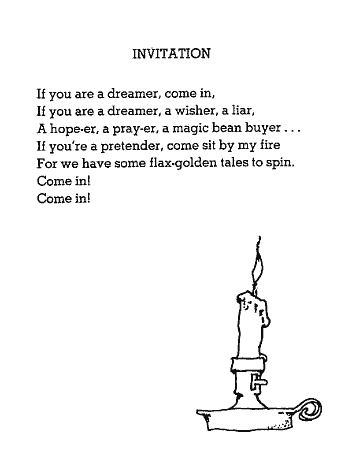
If You Are a Dreamer, Come In...

What I love about this poem (and I am not, by nature, a lover of poetry) is the use of second person, literally inviting the reader to join in the story-telling, the pretending, the imagining, rather than extolling the wonders of reading or imagination from a first or third-person point of view. Also, read aloud, the poem creates a nice tone to start a school year. It’s soft, warm, and inviting (come sit by my fire) and far from pushy or preachy. It’s exactly the tone I want to set in my classroom as my students start to read and discuss literature.
So, this school year, I want my students to be dreamers, hopers, pretenders, and wishers that imagine something new, wonder at what they read, and find unexpected meaning in stories. In June, if I’ve succeeded, they will feel comfortable reading and thinking, imagining, and are eager to spin their own flax-golden tales.
It’s the first day of school, Come in!
Wednesday, August 11, 2010
My Summer Vacation Essay

At the start of the day at Manos Unidas, a school for children with special needs in Cusco, Peru students file in through the bright blue doors and hurry to their classrooms. Ruth, the primary classroom teacher, works with five students age five and up, who trickle in. As they arrive, Ruth helps them hang their backpacks on nails, and sit on the floor where they start their day working with blocks. The students, who are still adapting to coming to school, are learning the most basic skills—how to sit in a group, table permanence (the idea that when you are at your seat, you are working), following one-step directions—not to mention the academic and functional skills that Ruth wants them to learn, like identifying colors and shapes, and using alternative communication to express their wants and needs.
Ruth and her students are the latest class to join Manos Unidas. The school is now at capacity with seven morning classes full of students who have a variety of disabilities (autism, developmental delays, Down Syndrome, and others). In the afternoon, the schools is filling up with students with learning disabilities or cerebral palsy who attend therapy and extracurricular programs.
In Cusco, Manos Unidas is one of a kind; Peru doesn’t offer special education programming for students. To fill the need, the Manos Unidas program was started in 2008 by Celeste Marion, an ABA therapist from Seattle, and Mercedes Delgado, a teacher in Cusco. As the program’s reputation has grown, students come from as far as two hours away.
In July and August, this summer, I volunteered for ten days with Ruth’s class. The work that Marion and Delgado are doing is fantastic. The kids are obviously learning and developing academic and social skills. Manos Unidas has a wonderful energy, the kids are so obviously excited to be there, eager to engage with the staff and learn. But, perhaps the most important thing that I saw was a dedication to training Peruvian teachers in special education best practices. There is currently no special education training for teachers in Peru and Marion relies on her own expertise, as well as volunteers to help bring best practices to her staff. Undoubtedly, in the long run, this will make Manos Unidas a locally sustainable school that isn’t dependent on anything but the expertise and creativity of their staff.
Above are the pictures of the students that I met during my visit (photo credit: Dawn Magnusson). For more information, please visit www.manosunidasperu.net.